
Glossophobia treatment: how to overcome the fear of public speaking

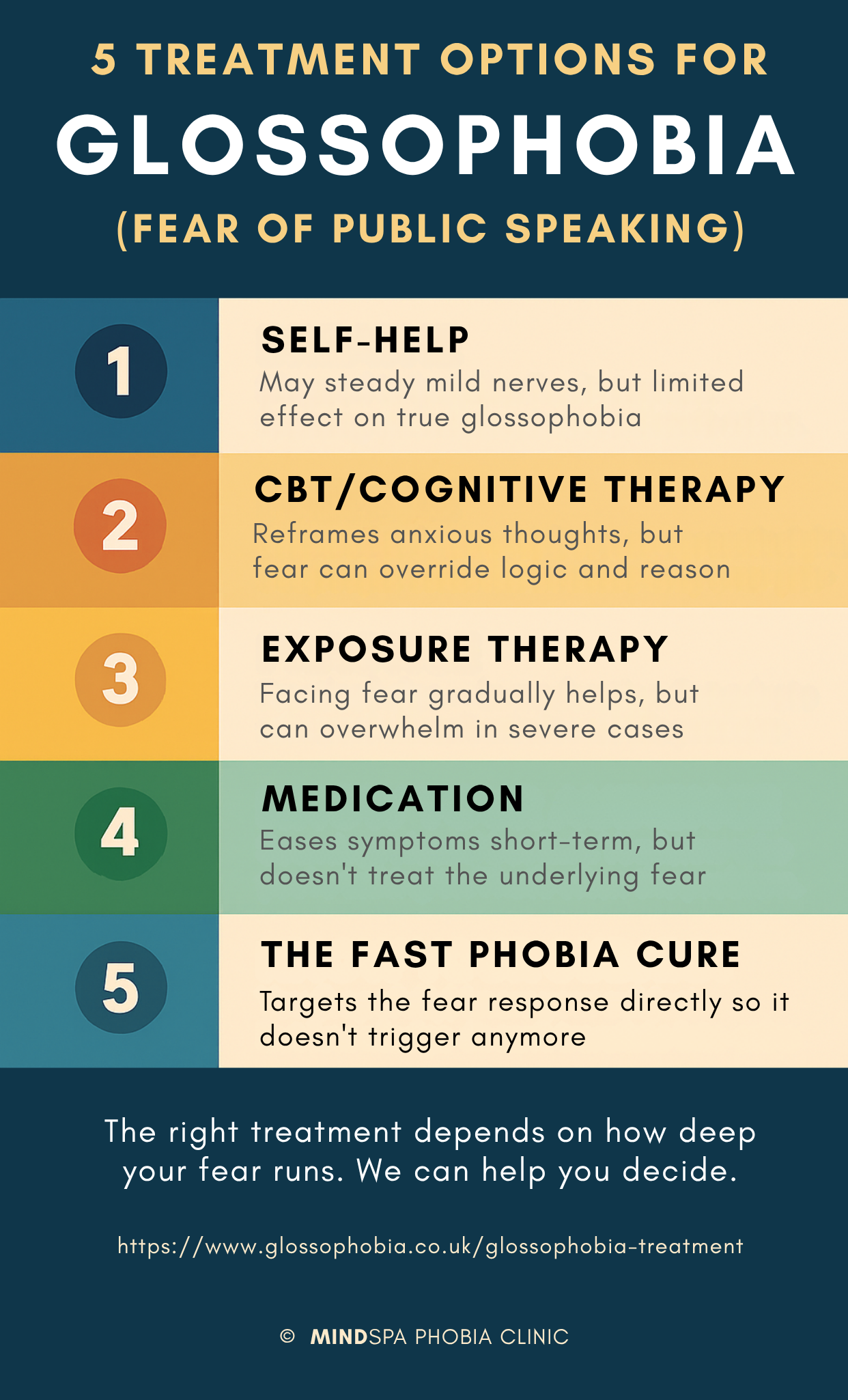
Infographic: 5 ways to treat glossophobia — self-help, CBT, exposure therapy, medication, and the Fast Phobia Cure

Glossophobia — the fear of public speaking — is highly treatable. The main options are cognitive behavioural therapy (CBT), gradual exposure therapy, and faster approaches such as the NLP fast phobia cure.


Which works best depends on how severe the fear is: mild nerves respond to self-help and practice, while intense avoidant glossophobia usually needs specialist therapy that targets the fear response directly.

Glossophobia treatment: how to overcome the fear of public speaking

Glossophobia — the fear of public speaking — is highly treatable. The main options are cognitive behavioural therapy (CBT), gradual exposure therapy, and faster approaches such as the NLP fast phobia cure.


Which works best depends on how severe the fear is: mild nerves respond to self-help and practice, while intense avoidant glossophobia usually needs specialist therapy that targets the fear response directly.

Infographic: 5 ways to treat glossophobia — self-help, CBT, exposure therapy, medication, and the Fast Phobia Cure

THE OPTIONS

What are the treatment options for glossophobia?

There's no single treatment for glossophobia. The right approach depends on how deep the fear runs. Here's an honest look at what's available, what each is good for and where some fall short.

THE OPTIONS

What are the treatment options for glossophobia?

There's no single treatment for glossophobia. The right approach depends on how deep the fear runs. Here's an honest look at what's available, what each is good for and where some fall short.

1

Self-help and practice

Preparation, rehearsal, breathing techniques and public speaking courses can steady mild nerves. But when the fear is a genuine phobia, the anxiety overrides these things. You can know your material perfectly and still freeze. Your breathing goes out of control. And despite having the skills, the fear still kicks in.

2

Cognitive Behavioural Therapy (CBT)

CBT works to restructure the negative thoughts behind the fear. It helps many people for many issues, but for glossophobia it has limits: the emotional survival response can override what you rationally know, and the gradual exposure it relies on can feel overwhelming. 


Read more on CBT vs the Fast Phobia Cure →

3

Exposure therapy

Facing feared situations gradually can reduce anxiety over time by teaching the nervous system that the threat never materialises. The difficulty: for severe glossophobia, each exposure can feel so distressing that people avoid it. Or if they don't avoid the exposure, they are frightened. In both cases the fear can be reinforced. 

4

Medication

Doctors sometimes prescribe beta-blockers to dampen physical symptoms - such as a racing heart - before a specific event. Medication can ease symptoms in the moment, but it doesn't treat the underlying fear or the dread beforehand. And people often don't want to rely on medication to manage their glossophobia. Any medical approach should always be discussed with your doctor.

5

The Fast Phobia Cure 

Rather than managing symptoms or slowly desensitising you, this approach targets the fear response directly — reprogramming the unconscious patterns that trigger the panic. It's how we help most clients overcome glossophobia in just two sessions. 


This is what we use. See how the program works →

1

Self-help and practice

Preparation, rehearsal, breathing techniques and public speaking courses can steady mild nerves. But when the fear is a genuine phobia, the anxiety overrides these things. You can know your material perfectly and still freeze. Your breathing goes out of control. And despite having the skills, the fear still kicks in.

2

Cognitive Behavioural Therapy (CBT)

CBT works to restructure the negative thoughts behind the fear. It helps many people for many issues, but for glossophobia it has limits: the emotional survival response can override what you rationally know, and the gradual exposure it relies on can feel overwhelming. 


Read more on CBT vs the Fast Phobia Cure →

3

Exposure therapy

Facing feared situations gradually can reduce anxiety over time by teaching the nervous system that the threat never materialises. The difficulty: for severe glossophobia, each exposure can feel so distressing that people avoid it. Or if they don't avoid the exposure, they are frightened. In both cases the fear can be reinforced. 

4

Medication

Doctors sometimes prescribe beta-blockers to dampen physical symptoms - such as a racing heart - before a specific event. Medication can ease symptoms in the moment, but it doesn't treat the underlying fear or the dread beforehand. And people often don't want to rely on medication to manage their glossophobia. Any medical approach should always be discussed with your doctor.

5

The Fast Phobia Cure 

Rather than managing symptoms or slowly desensitising you, this approach targets the fear response directly — reprogramming the unconscious patterns that trigger the panic. It's how we help most clients overcome glossophobia in just two sessions. 


This is what we use. See how the program works →

PRACTICAL STEPS

How to overcome glossophobia

If your fear is mild, these steps can genuinely help. If it's severe — if you avoid speaking altogether, or the dread starts days in advance — they may ease the edges but won't remove the fear. Knowing which situation you're in matters.

PRACTICAL STEPS

How to overcome glossophobia

If your fear is mild, these steps can genuinely help. If it's severe — if you avoid speaking altogether, or the dread starts days in advance — they may ease the edges but won't remove the fear. Knowing which situation you're in matters.

Understand what's happening

Glossophobia is a fight-or-flight response, not a flaw. Your nervous system has learned to treat an audience as a threat. Naming it as a conditioned reaction — not a personal failing — is the first step to acknowledging and getting help. And it is very common. So you are very far from alone.

Reframe what you are feeling

Nerves and excitement feel almost identical — racing heart, quick breath — so rather than fighting to calm down, some people relabel those sensations as excitement, which research shows helps you perform better. It won't dissolve a real phobia, but it can take the edge off ordinary nerves.

Understand what's happening

Glossophobia is a fight-or-flight response, not a flaw. Your nervous system has learned to treat an audience as a threat. Naming it as a conditioned reaction — not a personal failing — is the first step to acknowledging and getting help. And it is very common. So you are very far from alone.

Reframe what you are feeling

Nerves and excitement feel almost identical — racing heart, quick breath — so rather than fighting to calm down, some people relabel those sensations as excitement, which research shows helps you perform better. It won't dissolve a real phobia, but it can take the edge off ordinary nerves.

Remember it's not about you

The audience is far less focused on you than the fear insists — a bias called The Spotlight Effect — where we massively overestimate how much others notice our mistakes or care. Shift your attention from how you're coming across to what you're there to say, and the pressure eases.

Know when to get help

If you've tried courses, tips, and repeated practice and the fear still controls your choices, that's the mark of glossophobia rather than ordinary nerves. At that point it's not about more self-help — it usually needs specialist therapy that targets the fear itself.


5 Signs You Need Help With Glossophobia →

Remember it's not about you

The audience is far less focused on you than the fear insists — a bias called The Spotlight Effect — where we massively overestimate how much others notice our mistakes or care. Shift your attention from how you're coming across to what you're there to say, and the pressure eases.

Know when to get help

If you've tried courses, tips, and repeated practice and the fear still controls your choices, that's the mark of glossophobia rather than ordinary nerves. At that point it's not about more self-help — it usually needs specialist therapy that targets the fear itself.


5 Signs You Need Help With Glossophobia →

"I did my talk today in front of 200 people and I nailed it. When I got up on the stage a sense of calm came over me and I delivered my speech better than I ever could imagine. This is life-changing stuff. "


EJ   After two online sessions

WHAT OUR CLIENTS SAY *

"I did my talk today in front of 200 people and I nailed it. When I got up on the stage a sense of calm came over me and I delivered my speech better than I ever could have imagined. This is life-changing stuff. "

EJ

After two online sessions

"I did my talk today in front of 200 people and I nailed it. When I got up on the stage a sense of calm came over me and I delivered my speech better than I ever could have imagined. This is life-changing stuff. "

EJ

After two online sessions

OUR SOLUTION

How we treat glossophobia

We don't teach you to speak — you already have the skills. We remove the fear that gets in the way. Which is why it takes two sessions and not months.

OUR SOLUTION

How we treat glossophobia

We don't teach you to speak — you already have the skills. We remove the fear that gets in the way. Which is why it takes two sessions and not months.

Two structured sessions    

Two focused 90-minute sessions with a specialist therapist. The first removes the fear. The second installs lasting calm.

PRIVATE 1-TO-1  ·  IN-CLINIC OR ONLINE

High success rates  

We have very high success rates because glossophobia is the fear we treat most — so we know exactly what works.

REAL RESULTS  ·  LASTING CHANGE

Simple pricing 

The full program is £500. So no open-ended therapy, no ongoing commitment and no hidden costs.

A CLEAR TRANSPARENT FEE

READY TO BEGIN?

Speak to a specialist

No cost. No obligation. Just a conversation about how we can help. We'll give you an honest view on whether our program is right for you and what the best next step looks like.


Many clients tell us they feel relief just by making this first call:

No cost. No obligation. Just a conversation about how we can help. We'll give you an honest view on whether our program is right for you and what the best next step looks like. 


Many clients tell us they feel relief just by making this first call:

Speak to a specialist

CALL 0800 302 9452

7 days a week  ·  8am–8pm · Free call

OR

Have a specialist call you

CHOOSE A TIME

No cost · No obligation · 100% confidential

READY TO BEGIN?

Speak to a specialist

No cost. No obligation. Just a conversation about how we can help. We'll give you an honest view on whether our program is right for you and what the best next step looks like.


Many clients tell us they feel relief just by making this first call:

No cost. No obligation. Just a conversation about how we can help. We'll give you an honest view on whether our program is right for you and what the best next step looks like. 


Many clients tell us they feel relief just by making this first call:

Speak to a specialist

CALL 0800 302 9452

7 days a week  ·  8am–8pm · Free call

OR

Have a specialist call you

CHOOSE A TIME

No cost · No obligation · 100% confidential

READY TO BEGIN?

Speak to a specialist

No cost. No obligation. Just a conversation about how we can help. We'll give you an honest view on whether our program is right for you and what the best next step looks like.


Many clients tell us they feel relief just by making this first call:

No cost. No obligation. Just a conversation about how we can help. We'll give you an honest view on whether our program is right for you and what the best next step looks like. 


Many clients tell us they feel relief just by making this first call:

Speak to a specialist

CALL 0800 302 9452

7 days a week  ·  8am–8pm · Free call

OR

Have a specialist call you

CHOOSE A TIME

No cost · No obligation · 100% confidential

Speak to a specialist

CALL US NOW

Or have a specialist call you

CHOOSE A TIME

15 Minutes  ·  No cost  ·  No obligation

Glossophobia treatment FAQs

QUICK ANSWERS

Glossophobia treatment FAQs

  • How can I overcome my fear of public speaking?

    The fear is irrational: consciously you know the situation is safe, yet the unconscious mind triggers an automatic fear response based on learned patterns. To overcome it, those patterns need to be reprogrammed so the anxiety no longer triggers. This is exactly what specialist therapy does.

  • Does CBT help overcome glossophobia?

    CBT can help by restructuring negative thoughts, but on its own it's often limited for glossophobia. Although you may know speaking is safe, the emotional survival response can override rational thought, and the gradual exposure CBT relies on can feel overwhelming for severe cases.


    Read more: Overcoming Glossophobia: The Fast Phobia Cure v Exposure Therapy

  • Is there medication for glossophobia?

    Doctors sometimes prescribe beta-blockers to reduce physical symptoms such as a racing heart for a specific event. Medication can ease symptoms short-term but doesn't treat the underlying fear, and should always be discussed with a qualified doctor.

  • How much is the treatment program?

    The two-session program is a fixed fee of £250 per session, £500 in total. 


    Sessions are 90 minutes, delivered in clinic or online, with no ongoing weekly sessions or hidden costs.

This page is for general information and isn't a substitute for personal medical advice. As with all psychological interventions, there may not be a permanent cure in all cases, and individual results vary. Reviewed by Guy Baglow, Lead Therapist. Last reviewed: July 2026.