Mindspa Phobia Clinic • October 8, 2025

Top 7 Tips To Overcome Public Speaking Anxiety

(and why they don't help much)
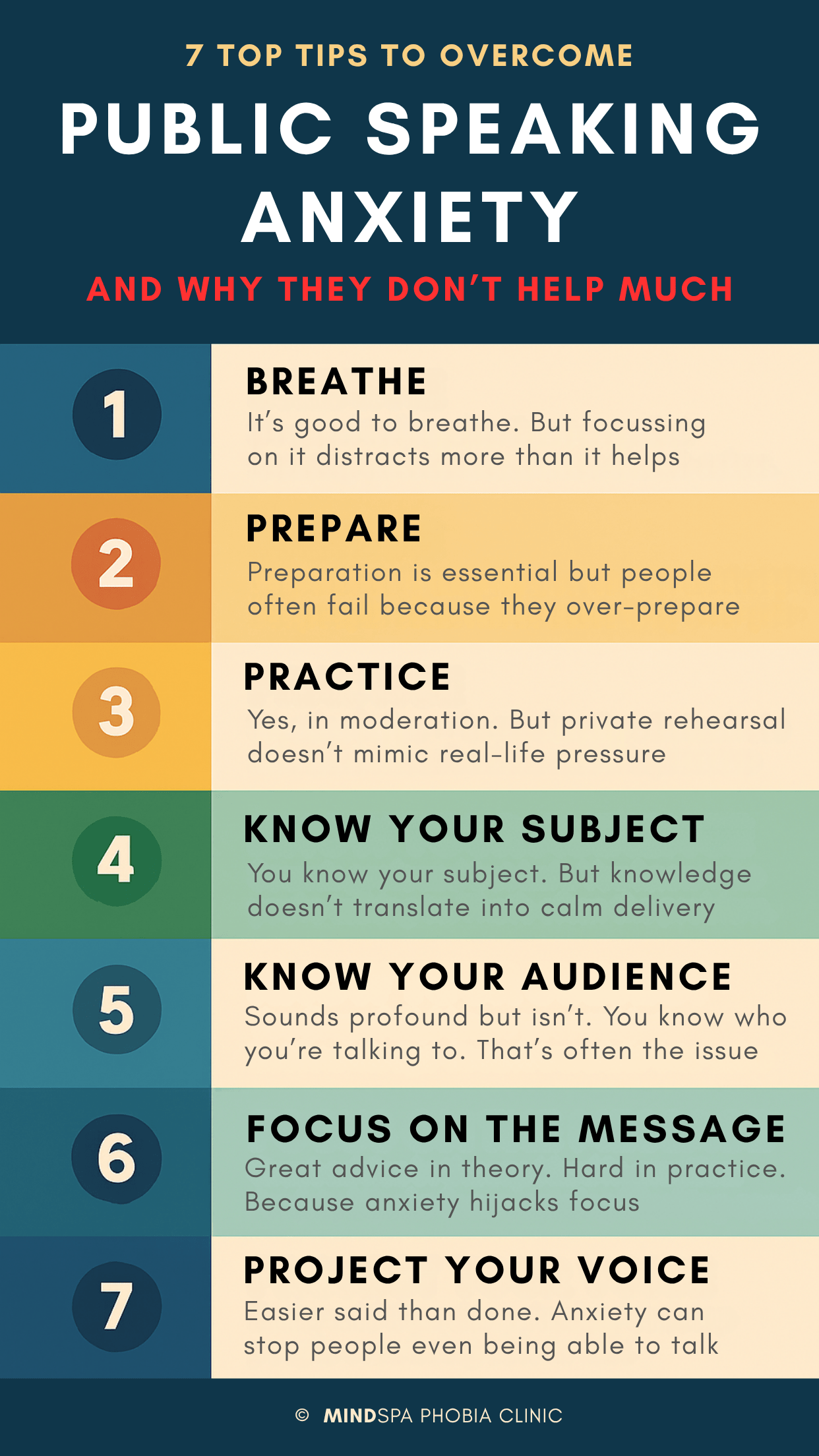
Top 7 Tips To Overcome Public Speaking Anxiety and Why They Don't Help Much

Public speaking anxiety advice often feels recycled: breathe, prepare, practice, know your audience, know your subject, focus on the message, project your voice. But when you are dealing with the white-knuckle fear of public speaking, these tips aren’t nearly as effective as they sound. Let’s break them down.


1. Breathe

Yes, it's good to breathe. Don't stop. But if you get to the point to where you have to try and manage your breathing, then it's probably already too late. The anxiety has already started to kick in. And if you try and focus on your breathing, you will lose focus on what you are talking about. And that's when the anxiety can spiral into full-blown panic.


2. Prepare

Prepare. Not a great insight. You need to prepare. Most people don’t fail because they didn’t prepare — they fail because they over-prepare, spending huge amounts of time and energy on a speech or presentation trying to control every detail to avoid the inevitable anxiety when actually speaking in public. Their speech then comes out unnatural and robotic, if it comes out at all.


3. Practice

Again, not a great insight. Of course you should practice. But practice is often presented as a cure-all. It isn’t. Practicing too much in private can backfire. Because you’re training yourself in a safe environment, you can feel ambushed when the real stressors — the audience, the stage, the eyes — appear.


4. Know Your Audience

This one sounds profound but often isn’t. You know who you’re talking to. If you’re giving a workplace presentation, you know it’s your colleagues. If you’re at a conference, you know it’s your industry peers. Being told to “know your audience” doesn’t actually lessen anxiety — it just reminds you that your audience exists and will be watching you. In fact, the more you think about who’s in the room, the more intimidating it can become.


5. Know Your Subject

This tip is equally redundant. If you’ve been asked to speak in public, it’s because you (hopefully) know your subject. Knowledge doesn’t automatically translate into calm delivery. Experts still choke, not because they don’t know their material, but because fear of judgment and performance pressure hijack their ability to express it smoothly. Anxiety isn’t about knowledge gaps; it’s about perceived social risk.


6. Focus on the Message, Not Yourself

This is good advice in theory — if only anxiety worked that way. Because anxiety hijacks focus. When public speaking anxiety kicks in, people focus inwards on what’s happening to them  - the pounding heart, the sweating, their shaky voice and hands - rather than on what they are trying to talk about. So in that moment it’s almost impossible to force yourself to focus outwards on the message.


7. Project Your Voice

What does this even mean in practice? For many anxious speakers, “projecting” is impossible — the effort to force volume just highlights how shaky they already sound. Instead of “public speaking,” it turns into “public squeaking.” The advice assumes you can override fear with technique, when often the fear can make it difficult to talk at all, let alone “project”.


The Reality Behind These Tips

All of these strategies have some value, but they don’t touch the root of public speaking anxiety. They don’t help people overcome the hardcore dread and fear that accompany public speaking. The problem isn’t a lack of knowledge, preparation, or technical skill — it’s the way anxiety rewires your body and mind under pressure. Until that deeper issue is addressed - through specialist therapy - these surface-level tips can feel hollow and may even be counterproductive.


That's why at the Mindspa Phobia Clinic we don't bother with tips and tricks to overcome public speaking anxiety. We deal with the fear.


With our powerful and effective Public Speaking Program you can break free from stage fright, overcome public speaking anxiety, and regain confidence in every speaking situation.


5 Signs You Need Help with  Glossophobia or Public Speaking Anxiety
By Mindspa Phobia Clinic October 4, 2025
Discover the 5 signs of glossophobia—also known as stage fright or public speaking anxiety—and learn how to manage symptoms and build confidence.
NLP Fast Phobia Cure vs CBT Exposure Therapy
By Mindspa Phobia Clinic September 8, 2025
Struggling with glossophobia? Discover why exposure therapy falls short for public speaking anxiety and how NLP Fast Phobia Cure offers rapid relief.
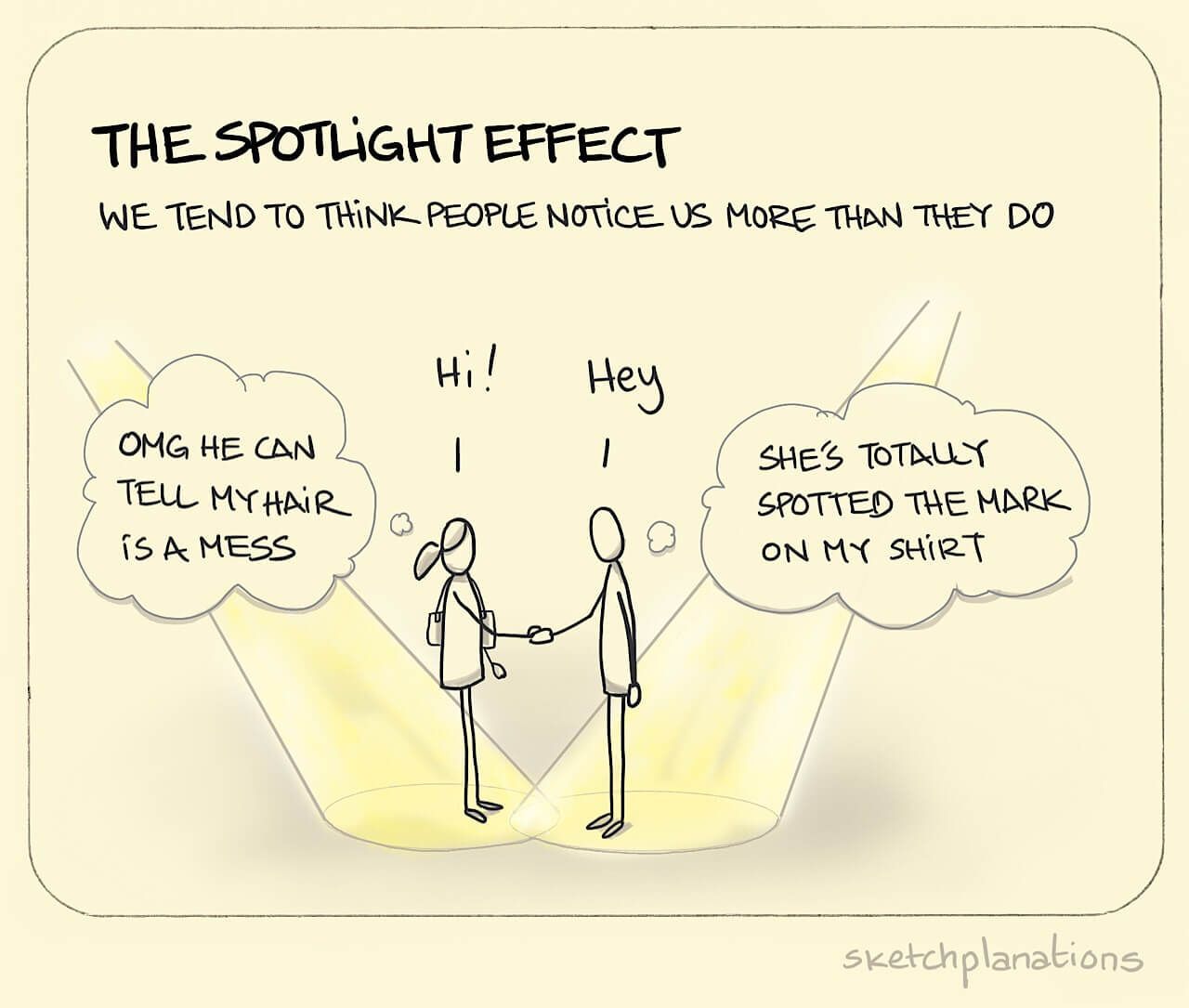
Two people experiencing The Spotlight Effect and social anxiety
By Guy Baglow (Clinical Lead, Mindspa Phobia Clinic) September 4, 2025
Why does it feel like everyone is watching you? Discover the psychology behind the Spotlight Effect and its role in public speaking fear and glossophobia.
By Mindspa Phobia Clinic January 19, 2025
Guy Baglow, clinical lead at the Mindspa Phobia Clinic, was interviewed in an article about the treatment of unusual phobias.
A glossary of terms related to Glossophobia and therapy to overcome it
By Mindspa Phobia Clinic January 18, 2025
Understand glossophobia (public speaking fear) and treatments to overcome it with this useful glossary, including CBT, stage fright and exposure therapy.
A microphone on an empty stage waiting for the speaker
By Mindspa Phobia Clinic January 12, 2025
Avoidance by people with glossophobia reinforces fear. Avoiding public speaking may give temporary relief but limits career growth and strengthens anxiety.
By Guy Baglow (Clinical Lead, Mindspa Phobia Clinic) April 12, 2024
Glossophobia is a specific fear of public speaking, but is it a form or social anxiety or should it be treated as a distinct issue?
By Mindspa Phobia Clinic January 1, 2019
Lucy shares how the "Fast Phobia Cure” helped her conquer her glossophobia and overcome her fear of public speaking at the Mindspa Phobia Clinic.
By Mindspa Phobia Clinic November 2, 2017
Chris Evans, The Guardian, 12 June 2017
By Mindspa Phobia Clinic November 2, 2017
The Fast Phobia Cure (also known as the Rewind Technique or, in Neuro Linguistic Programming (NLP), as “The Visual-Kinaesthetic Dissociation Technique”) is an advanced tool to decondition phobias and trauma (such as PTSD). Its efficacy has been assessed in many academic papers such as the work by Gray & Liotta. It’s safe, gentle and without the drugs, scare tactics, psychological archaeology and exposure used by the older and less effective phobia treatments. The Fast Phobia Cure* is now widely accepted as the most reliable and effective treatment for all kinds of phobias, even long-standing and severe ones. It’s probably the single most reliable and effective tool in psychotherapy today and is being used more and more as a front-line treatment for Post-Traumatic Stress Disorder including trauma caused by accidents, assaults, war and witnessing critical incidents. If you have ever seen someone being almost instantly released from their phobia on TV and thought “Wow, how did they do that?” you can bet the therapist used The Fast Phobia Cure. So how does it work? A phobia is driven by a pattern-matching process whereby the unconscious mind creates “fear templates” around “dangerous” things or situations to try and keep you safe from the imagined threat in future. It then broadly matches these patterns to more and more situations as a phobia develops. What Fast Phobia Cure does, in a very creative way, is interfere with those patterns – it subtly changes the templates by changing the way we experience the memories – so when the unconscious mind tries to match the patterns, they don’t match anymore and the anxiety is no longer triggered. The templates (memories) will still be there, they will just feel different. The emotional tag will be gone. The phobia just won’t work anymore. This can all be done very quickly because the brain learns very fast. It learned to be phobic very fast. Teaching it how not to be phobic can be, and is necessarily, equally fast. It does not take long-term treatment. The mind can then start to generalise outwards, but this time in a very positive way, as it begins to associate more and more situations with feelings of calm and control. One of the great things about The Fast Phobia Cure is that it is non-intrusive: the therapist doesn’t need to know the precise details of the traumatic memories or phobic encounters because the sufferer brings their content (their experiences) to the process. The methodology of the Fast Phobia Cure was first developed by Richard Bandler, one of the founders of Neuro Linguistic Programming (NLP) – the new science of excellence and personal change. It is so effective at detraumatising memories that it is being used more and more as a front-line treatment for Post-Traumatic Stress Disorder including trauma caused by accidents, assaults, war and witnessing critical incidents.